We’ll be happy to help via online chat or at: orders@premiumbarefoot.com

Stories and Brands Walking, Movement and Health
What’s it like to set off in barefoot shoes on the famous pilgrimage to Santiago de Compostela?
Do you know that feeling when you want to sack it all off, hand in your notice and just leave? Somewhere. Anywhere. Just away. Well, don’t overthink it—go! It sounds like a cliché from a motivational leaflet, but don’t worry: in this article about walking to the Spanish pilgrimage destination of Santiago de Compostela, you won’t find any profound musings on the meaning of life, or photos of sunburnt bellies on a beach.
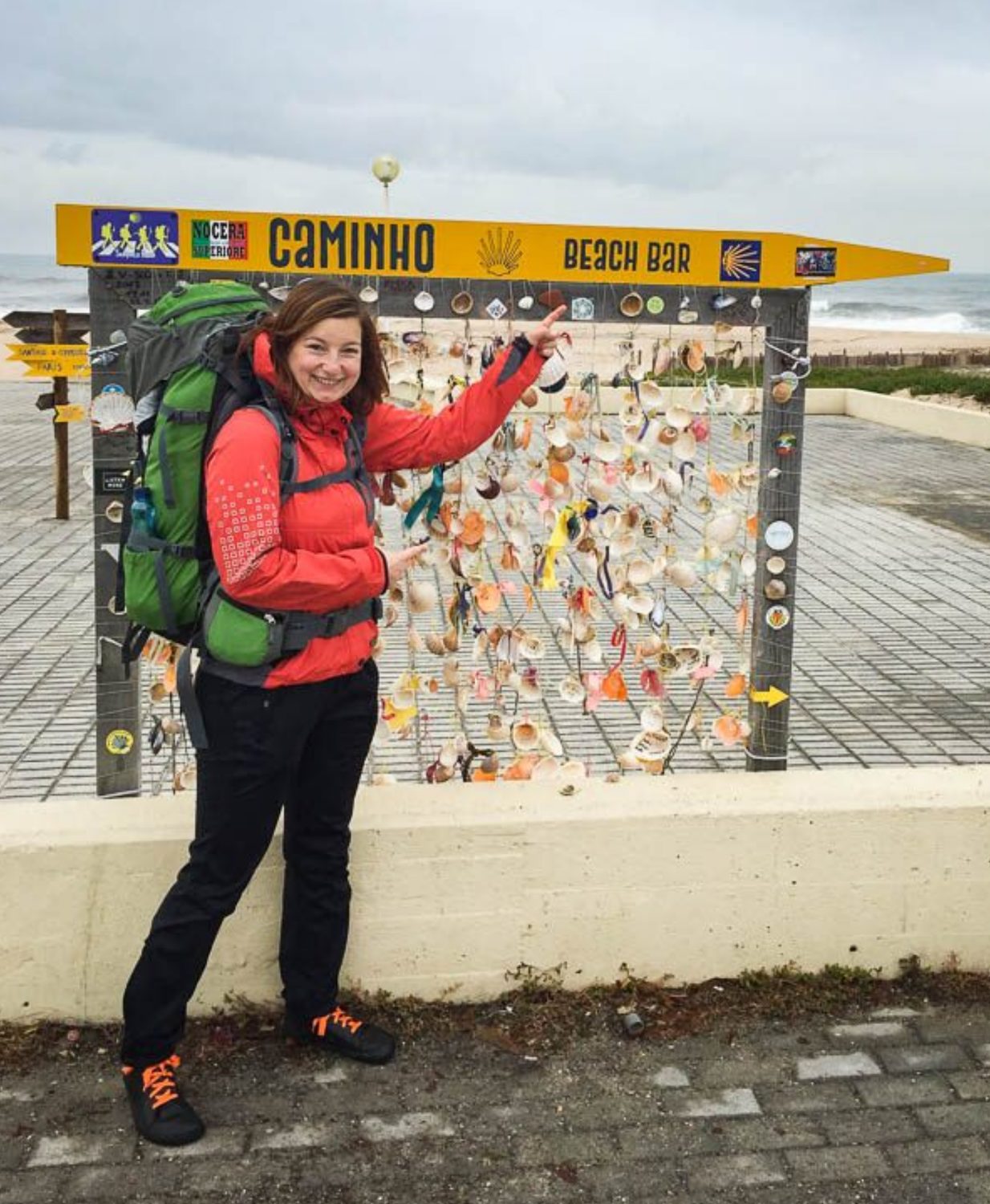
Instead, I swapped it all for an adventurous walk along the Portuguese–Spanish coast—and in November, the rainiest month of the year. 260 kilometres with a freshly recovered ankle inflammation, no training, a 10–12 kg load on my back, and in barefoot shoes. What can I say—it was a perfectly ill-thought-out plan. If you fancy a similar adventure, go for it.
So I’d have someone to share the joys, the struggles and the sore feet with, I talked my friend Hanka into coming along. And then Karel joined us on the way—unexpected and uninvited. But more on that later.
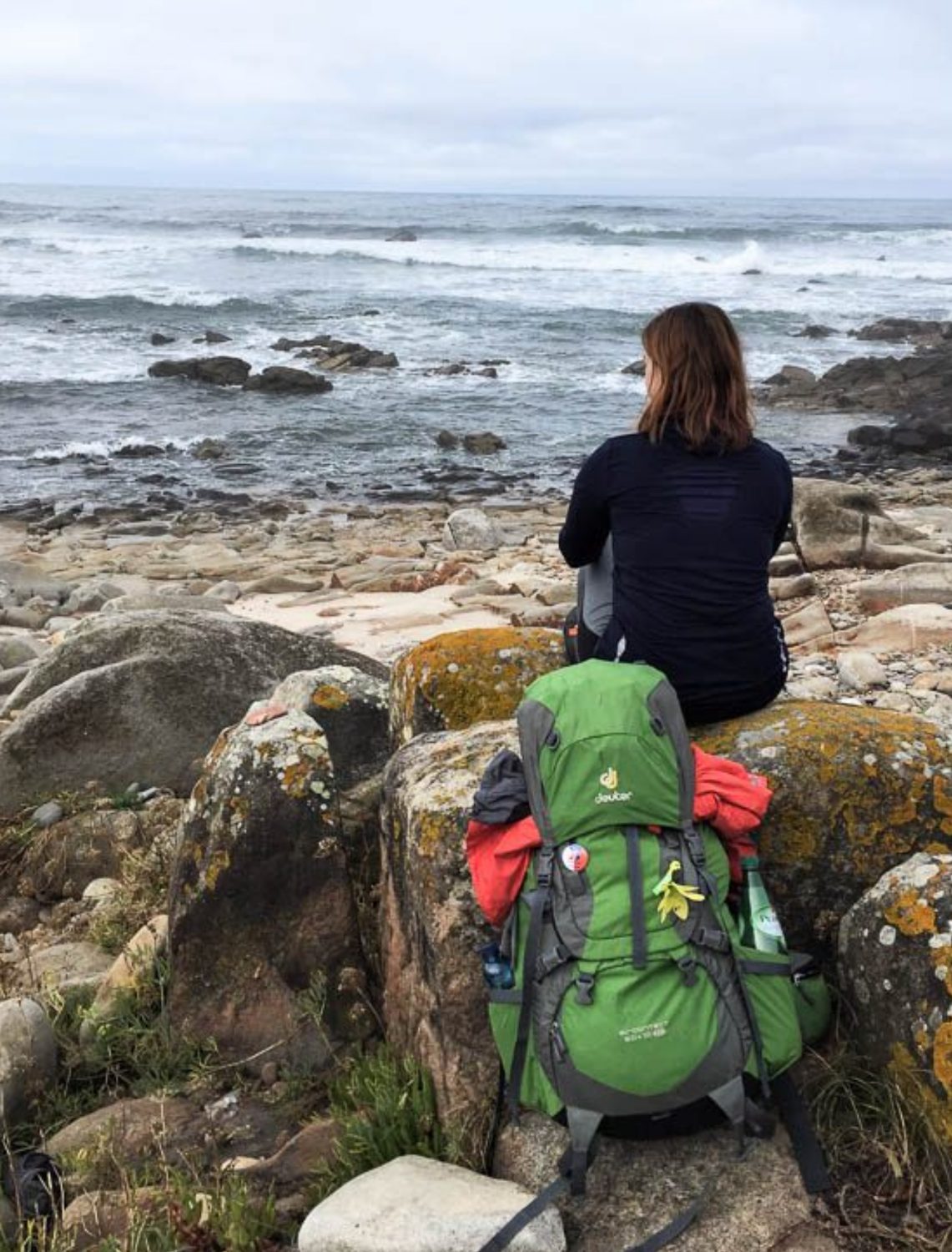
On pilgrim websites you’ll read that the essential piece of kit for a walking pilgrimage is, first and foremost, proper footwear. So Gore-Tex hiking boots with a cushioned sole that practically walks for you would be ideal. Except you can tell my stubborn, newly barefoot-obsessed self whatever you like—I’ll still do it my way. Literally. They also advise you not to carry heavy things, not to collect souvenirs and other pointless extras. Guess how much my rucksack weighed—and how much of that was “keepsake” pebbles.
But yes, kit really is key. A well-padded trekking rucksack that supports you on rough ground and doesn’t weigh much itself (stick to classic outdoor brands—your back will thank you). Technical clothing so you don’t smell from a mile away after day one (the much-praised merino really did deliver). And above all – a proper raincoat. Because the weather can be sneaky even in Spain. Who would’ve thought? We certainly didn’t...
One interesting thing about this pilgrimage is that there’s only one destination—that picturesque cathedral in northern Spain—but there are hundreds of starting points. Really, thousands. You can start, for example, right outside your front door and simply head towards Santiago de Compostela. Sooner or later you’ll come across the charming yellow arrows, which will guide you the whole way. And trust me: once you start looking for the yellow arrows, they’ll suddenly pop up everywhere.
Routes even run through the Czech Republic. You can check whether one starts under your balcony on the Czech website Ultreia, where you’ll find comprehensive information about the journey—aka the Camino.
It hasn’t been “just” a pilgrimage for believers for a long time. On the Camino you’ll meet an incredible mix of people, each with their own story—and most are happy to share it. Unfortunately, we had limited time for the route and for fellow pilgrims’ stories, so we chose one of the most well-trodden options – from Porto in Portugal, about 260 km. November isn’t exactly the best choice for long hikes anywhere, let alone in a far-off country whose pitfalls you know nothing about. And that’s exactly what adventures are made of. So, Buen Camino!

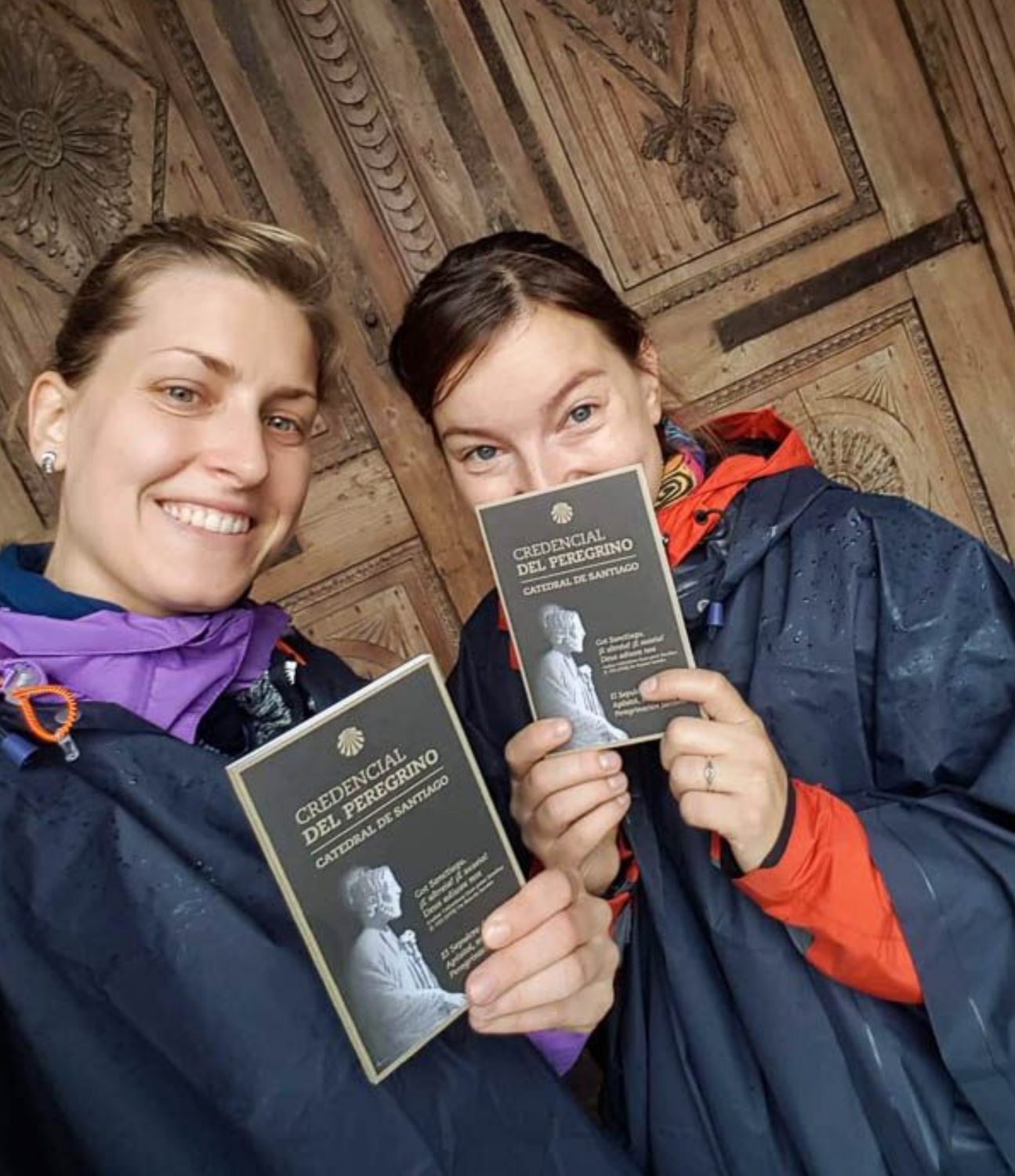
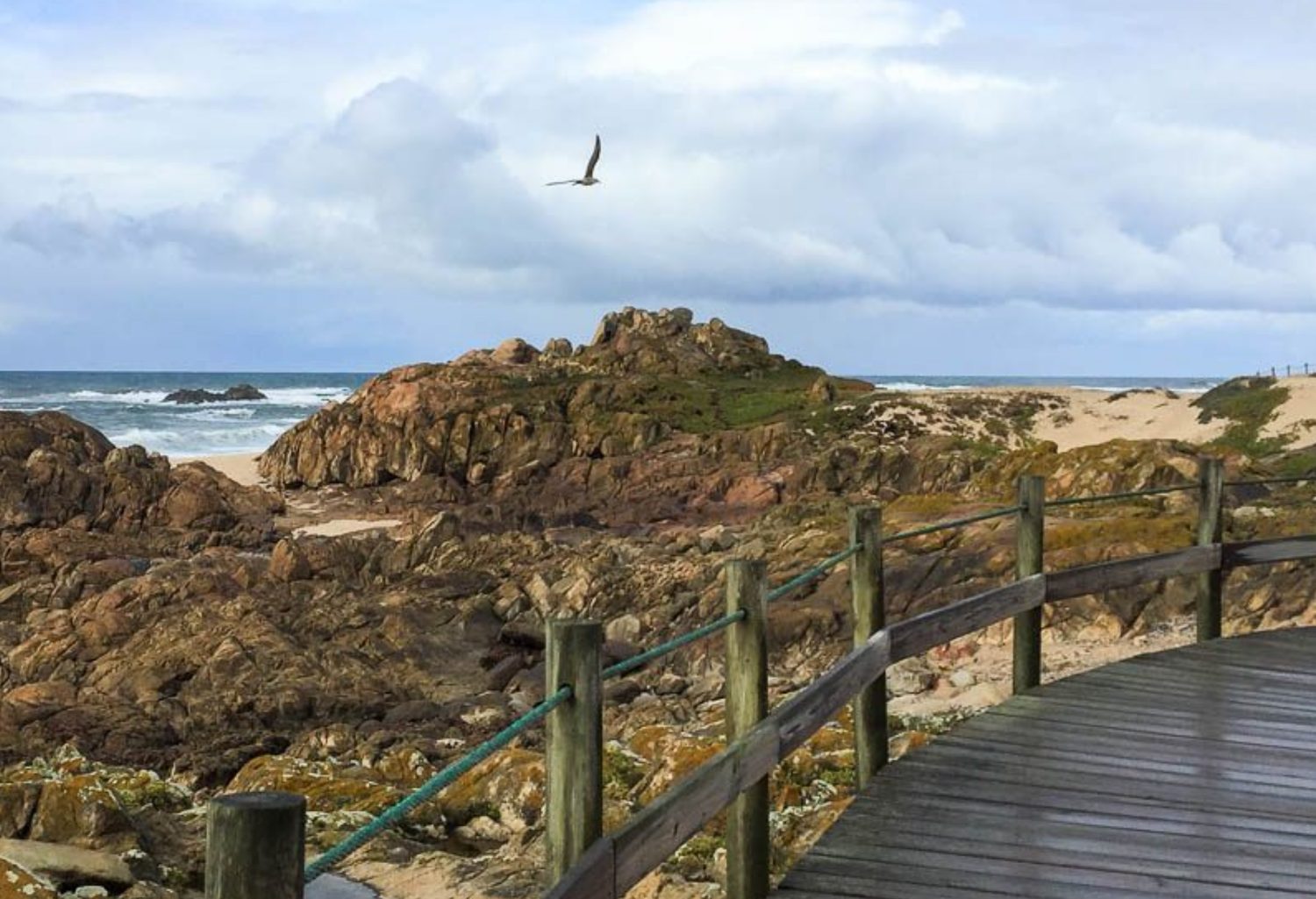
It’s raining. It’s raining in the evening as we discover the beauty of Porto’s colours, tiles, cork and wine. And it’s raining in the morning as we frantically hunt down a credencial—the pilgrim passport (you collect stamps in it along the way, and it also helps you secure a clean bed in pilgrim hostels called albergues). And so I tested, for the first time, the water resistance of my leather barefoot shoes. To be fair, they held up for a respectable while. The first kilometres along the wooden boardwalk by the ocean were no problem at all. In the end, though, they gave in. Which I forgave them—because when it’s raining from above, from the side and from below, you don’t stand a chance. Hanka’s soaked “proper” hiking boots confirmed that too.
Day one. First 22 km. First soaking. Joy and excitement alternated with thoughts like: Bloody hell, are we going to walk another 240 kilometres in the rain? Another 9 days? This rucksack feels heavy. Barefoot shoes weren’t the best idea. A raincoat and wind are not exactly mates. But it never lasted long. The ocean views—and every other drenched pilgrim smiling and greeting you with “Buen Camino”—didn’t give gloomy thoughts a chance. Because the Camino is what you make it. And why suffer over something you can’t control anyway? So—onwards!

It goes beautifully like this until your head, shoulders, knees and hips start complaining—and until you meet Karel. Karel joined us on day two. Apparently he took a liking to us and invited his mates too, so we ended up hosting several of them. Right on the most sensitive spots on our soles. Hilarious travel companions.
But you know what? The ocean is murmuring on your left, and you keep walking because you want to—no one is forcing you—and even with blisters it’s still good. Rain or no rain. Pain or no pain. The weight of deadlines, unfinished tasks and even Karel falls away, replaced by the only truly important question of human existence: What are we going to eat?
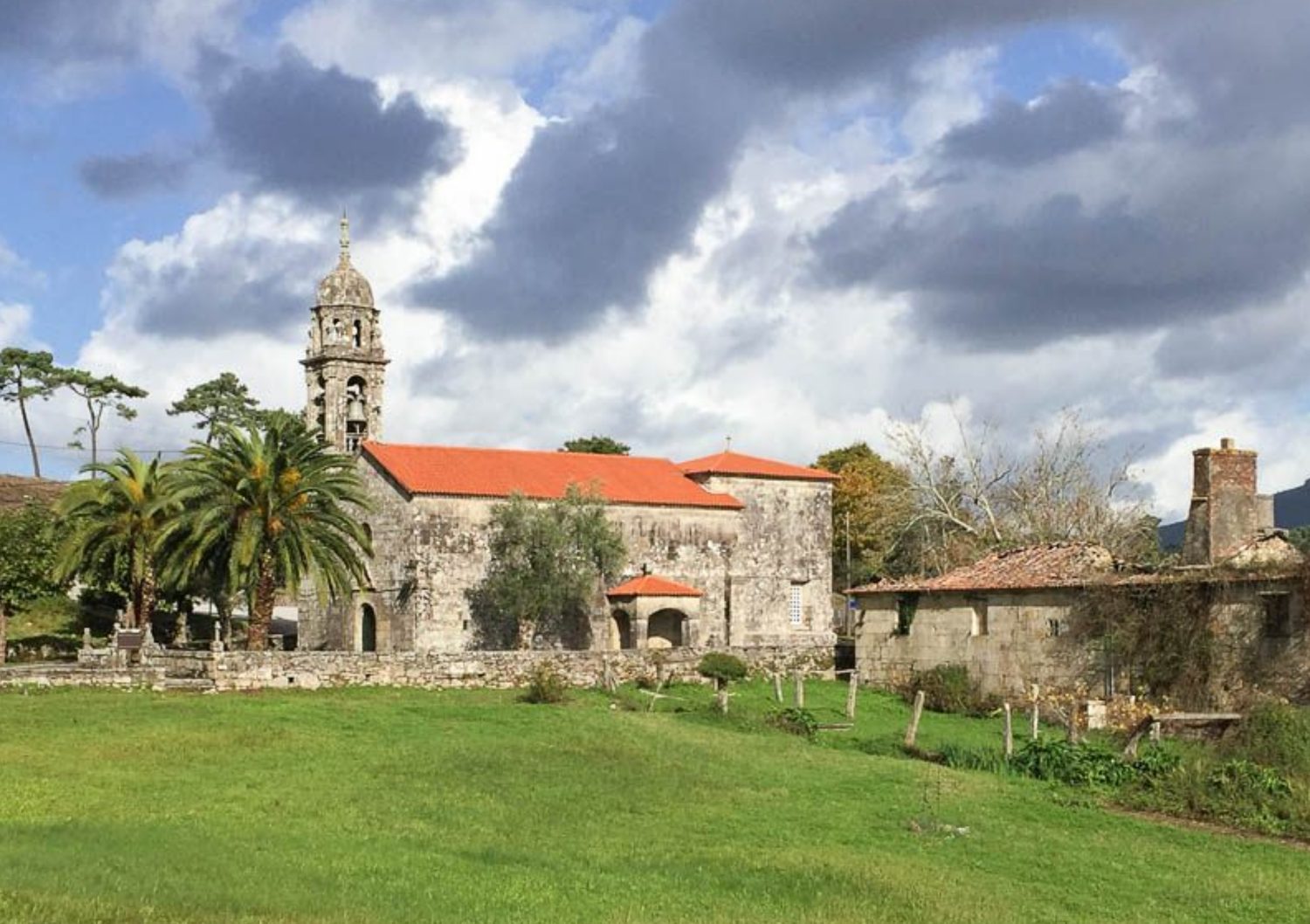
“It’s raining loads, everything hurts, and downhill hurts the most.” That’s what my notes look like halfway through. But karma works, and the bad is always followed by the good. Sometimes it only takes a seemingly tiny thing to bring you back to feeling alright. The sun comes out. You spot a rainbow. You pass a herd of cows. Someone takes a photo of you by a medieval stone church so you don’t have to do another awkward selfie. Or you simply take your shoes off for a moment and have a good coffee. I recommend treating yourself to a little moment of joy like this every day—and finishing it with a glass of delicious Portuguese/Spanish red. Or three.
Along the way, cafés and restaurants are used to pilgrims. With an extra dash of kindness, they’ll take pity on you and let you dry your shoes by a warm fireplace, for example. Along the Portuguese route there are thankfully plenty of places like that. No one thinks it’s odd that your rucksack is decorated with wet socks, and when you walk in, a little ocean forms beneath you—sometimes water, sometimes sand. Although most locals have never walked the Camino, they have respect and understanding for pilgrims.
A definite perk of the pilgrimage is the accommodation—albergues—scattered along all routes roughly so that there’s one for each day. Or at least every other day. And although heating isn’t really the norm in Portugal or Spain, albergues are equipped for cold and rain with a fireplace or electric heaters. And that’s usually enough for socks, shoes and your T-shirt to dry overnight.
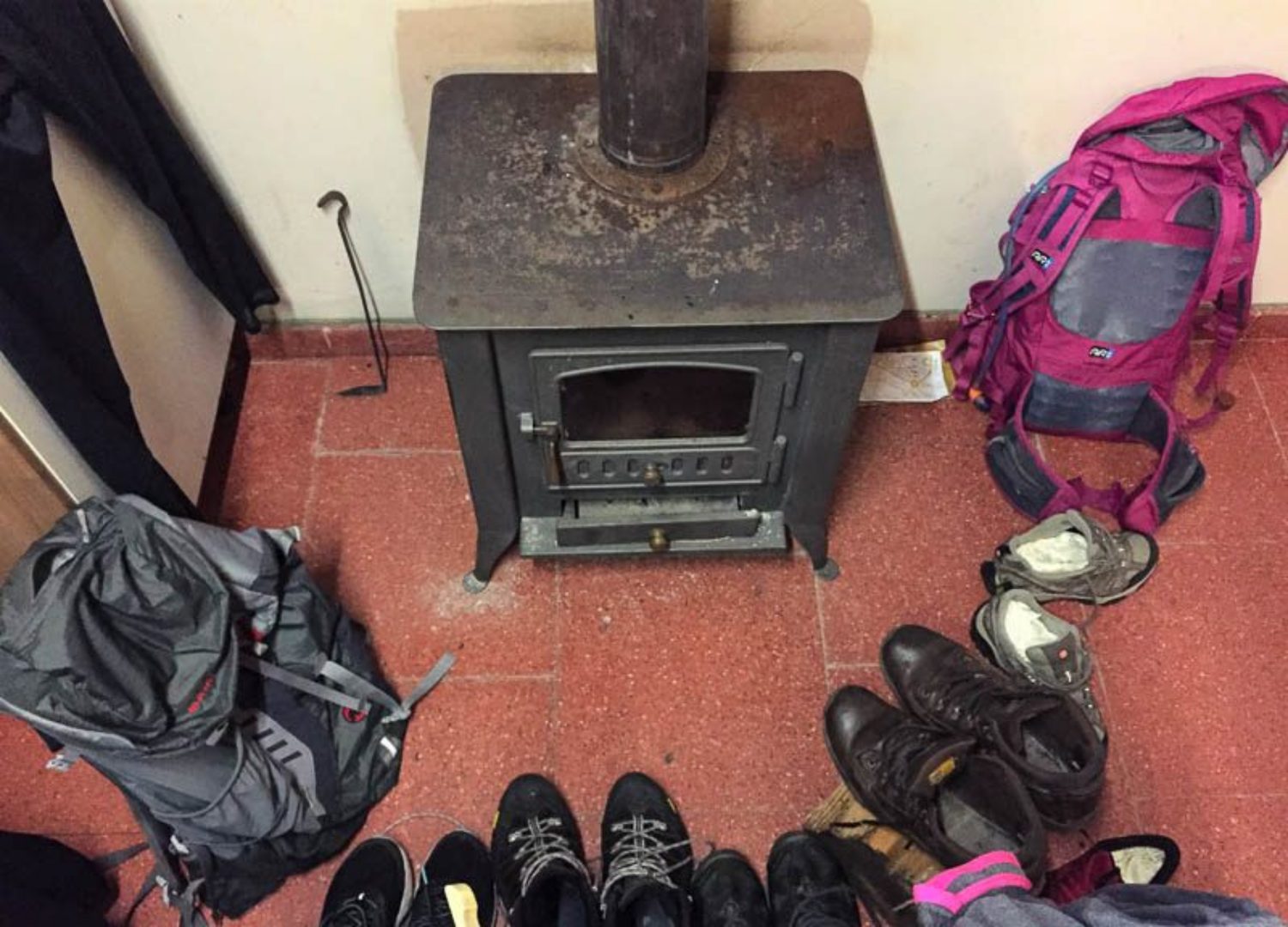
“Take care of yourselves—and above all, keep your feet warm,” Hanka’s dad said as he saw us off. Easy to say, but try it when it’s raining so hard it makes no difference whether you jump over a puddle or step straight into it. But the world is still beautiful—even when you’re limping through it and Karel makes himself known with every step.
That reminds me: online you’ll find loads of great advice on foot care for a long-distance walk. For example, wearing two pairs of socks so your feet don’t rub as much and blisters don’t form. It works—honestly. Shame I only discovered it halfway through. Still, I have to say my barefoot Karel, compared to Hanka’s several, was just a small nuisance that could be reasoned with—and disappeared after two days. Hanka, in the recommended cushioned hiking boots, had a lot more “fun” with hers.
Another miracle is kinesiology tape, which can ease a sore knee—and therefore the hip too. Until the other one starts hurting. And an unbelievable healer is calendula ointment. Apply it morning and evening. I believed this habit would stick with me at home too. Looking after the feet that carry you through your whole life is essential. But you know how it is—if I remember once a week, that’s already something. Don’t be like me.
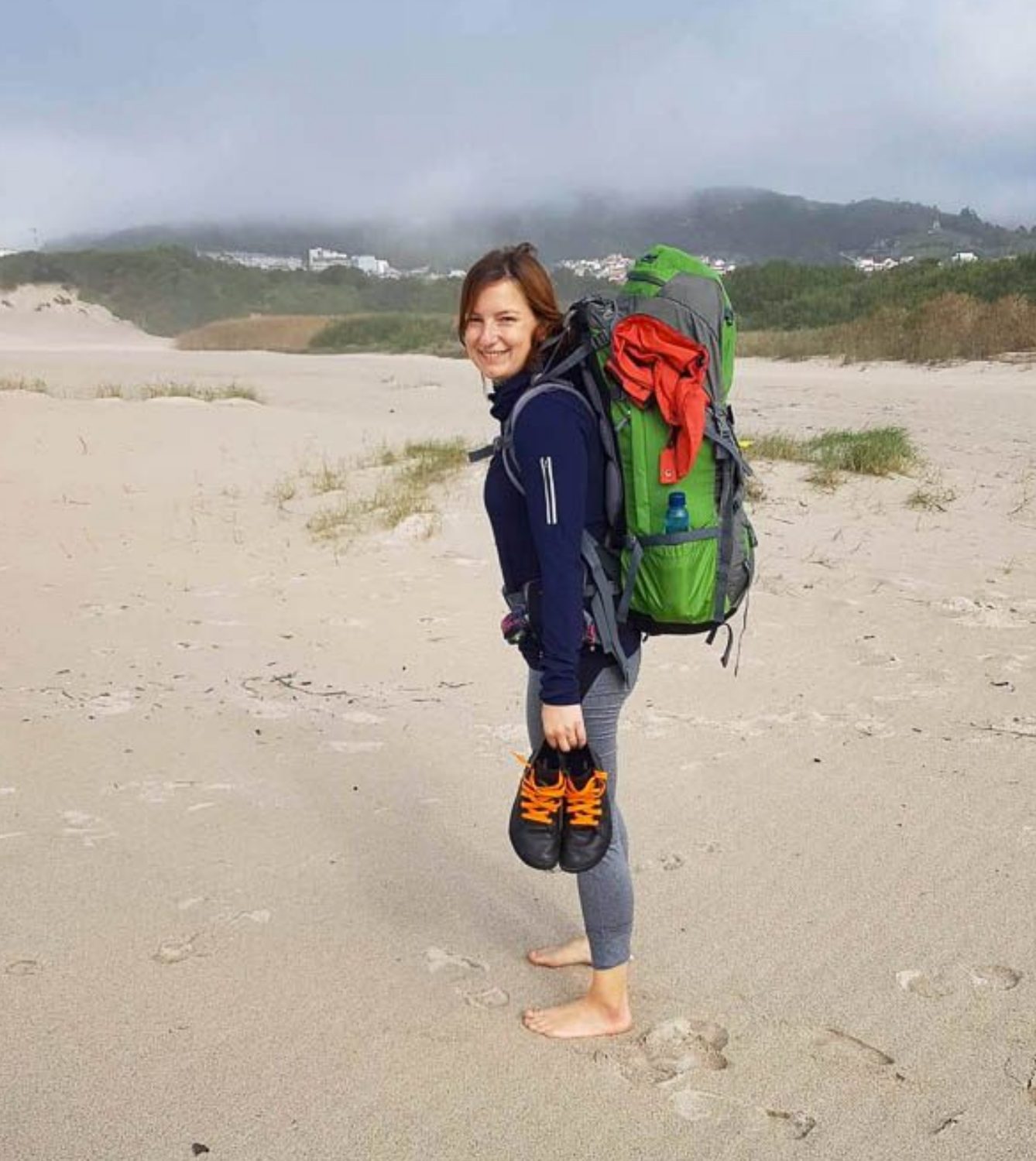
Walking as a pair has its perks. You’ve got someone to share those thousands of excited, curious thoughts about life with; someone to moan to about aches and pains; and someone to repeatedly remind that you’re hungry. But it’s really important to find balance in all of it. Because sometimes—and more and more towards the end—you naturally crave silence and simply walking. On. Alone. In the confession booth of your own thoughts.
And sometimes you need to interrupt those deep, inward moments with a perfectly absurd burst of pure joy. When one of you suddenly comes out with the quote of the century: “Look, I’ve become a millionaire—I own two massive swimming pools. In my shoes!” Or you meet a seventy-year-old granny in a long softshell skirt instead of an apron, walking the Camino for the fourth time, and you soak up her wisdom—and her fear of bedbugs. In the end she gives you her phone number and promises that if you ever come to Australia, you’ll have somewhere to stay. If she could, she’d probably bake us a tray of buns too. Compared to her 600 km from Lisbon in sandals, our 260 km and half her age made us look like absolute amateurs. I hope I’m like her one day.
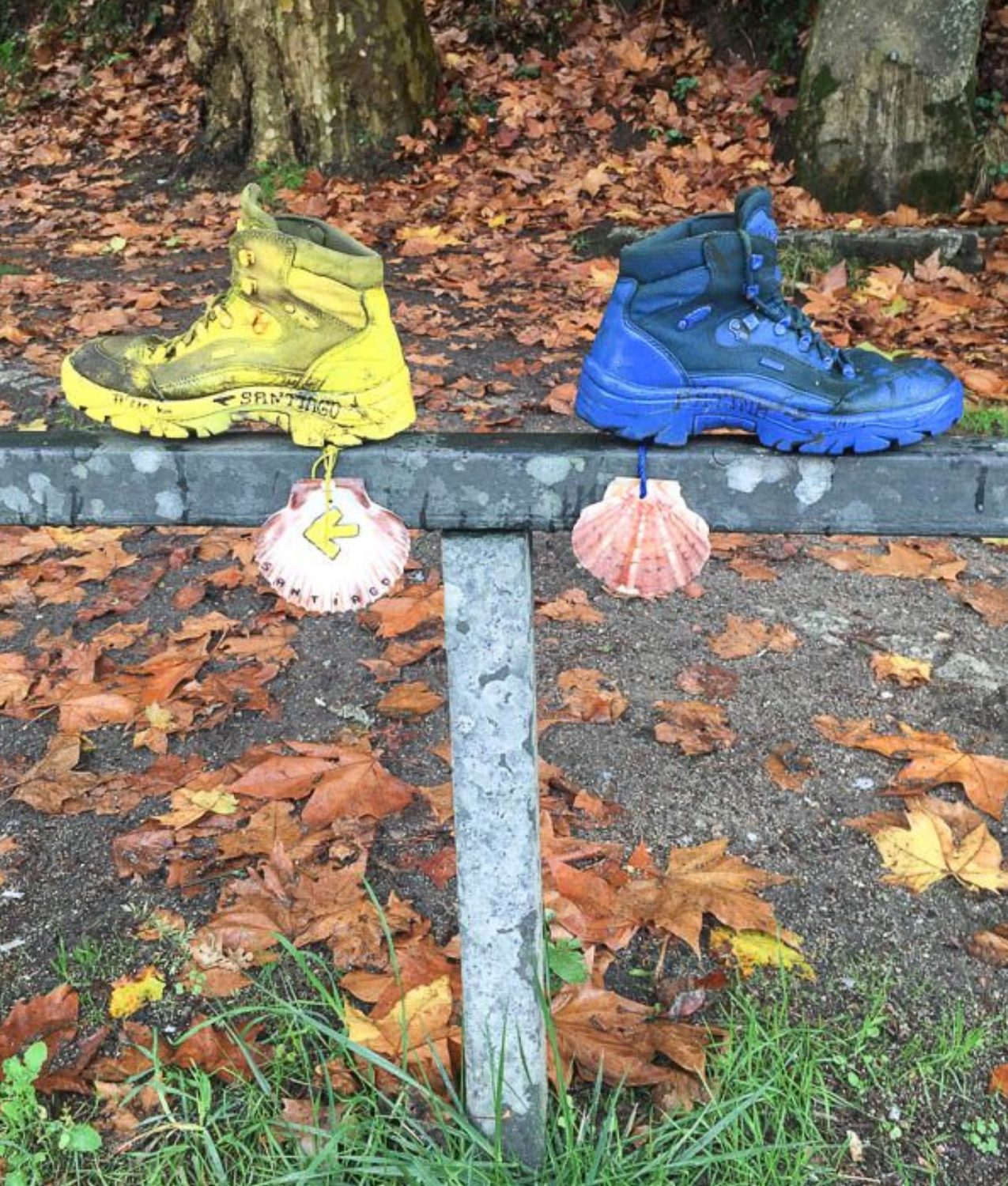
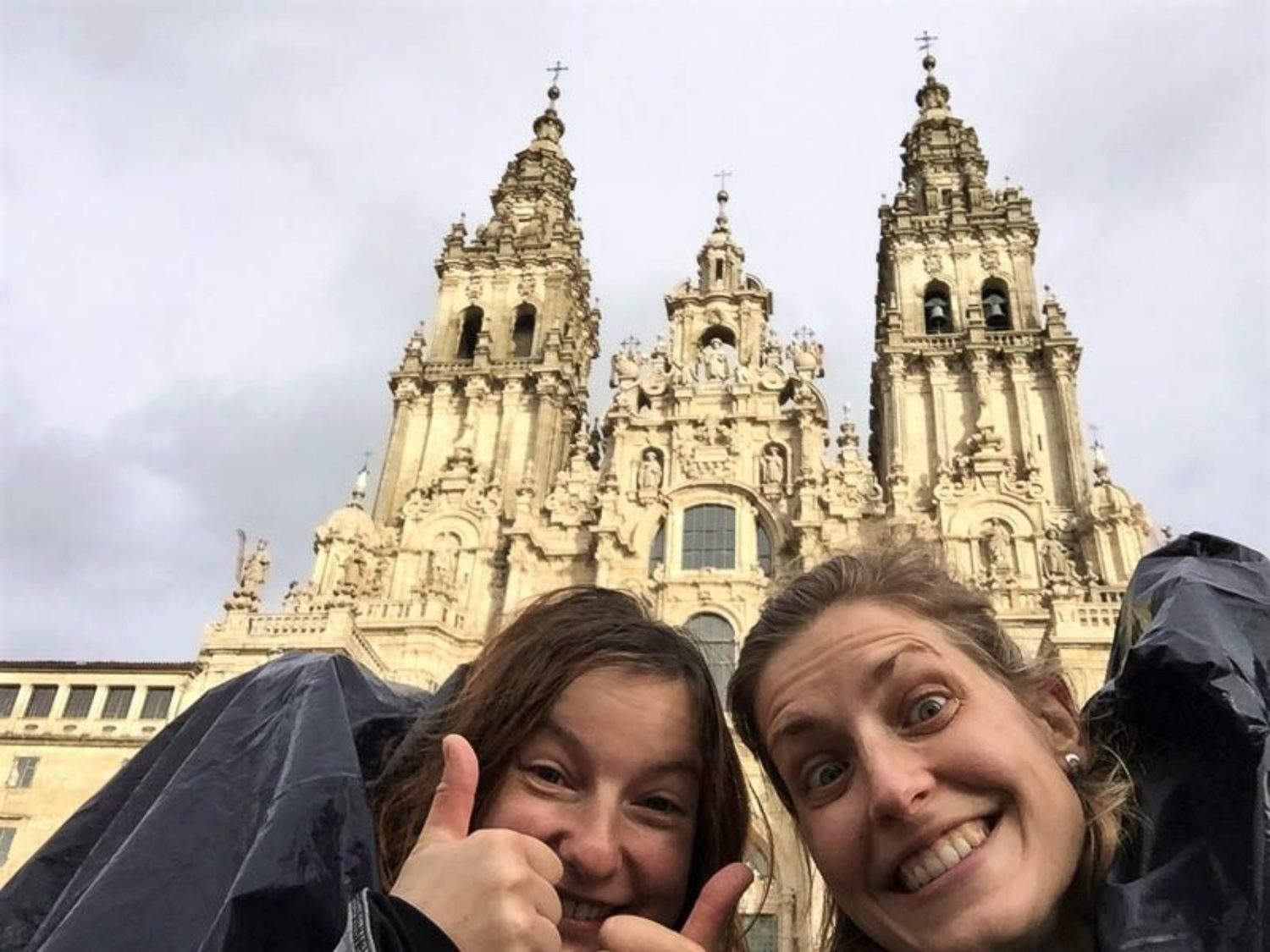
We walked around 30 km a day. At the start, those 260 felt unbelievably far away. And as the number dropped, the excitement grew that the finish was getting closer. But as it started to get dangerously close, disappointment appeared too—that the whole adventure would end. Along with curiosity about what it would feel like to arrive and stand in front of the cathedral. The last kilometres were cheerful. The weather changed every five minutes and we didn’t care anymore. Same with the fact that we reached the cathedral via a long detour. Because suddenly, there it was. In all its beauty. And there we were too. It was an incredibly blissful feeling of a small, big victory—mixed with sadness that it was slowly, surely coming to an end.
The Camino brings plenty of tough but beautiful moments—tiredness, exhaustion, hunger, sadness and homesickness, but above all laughter and joy. You realise how incredible the human body is. How grateful we should be to it. That when something hurts, there’s a reason—and usually we’ve brought it on ourselves. Sometimes even by choosing the wrong footwear. That’s not my case though: walking in barefoot shoes was an absolutely brilliant idea.
Would I go again? Absolutely—tomorrow, if I could!
The Camino de Santiago was also walked by photographer, adventurer and Northern Lights guide, Marek Rybář. He comfortably completed the full 110 km in XERO SHOES HFS.
Watch his video from the journey:
Which shoes should you choose for a long-distance hike?
 What else might interest you on this topic?
Text and photos: Eva Holíková


You are currently on www.premiumbarefoot.co.uk


 £ - EN
 Čeština
 English (US)
 Slovenčina
 Magyar
 български
 Polski
 Dansk
Dansk
 Nederlands
 Svenska
 Suomi
Suomi
 Español
 Français
 Slovenščina
 Română
 Português
 Deutsch (DE)
 Deutsch (AT)
 Deutsch (CH)


